 Slimepress
NVIDIA Unveils RTX Spark Superchip and AI Agent Platform, Partnering with Microsoft to Launch the Era of Agentic PCs
During its Computex 2026 keynote, NVIDIA unveiled a series of major technologies and products aimed at shaping the future of AI-powered personal computing. The announcements included the new RTX Spark Superchip designed specifically for AI Agents, a local AI Agent platform developed in collaboration with Microsoft, Adobe's redesigned Premiere Pro and Photoshop engines optimized for Spark, and the next-generation DLSS 4.5 Ray Reconstruction technology. From hardware architecture and operating systems to security frameworks, creative applications, and gaming technologies, NVIDIA's message was clear: AI Agents are rapidly becoming the next major computing paradigm for personal computers, and RTX Spark is the platform built to power that future.
During its Computex 2026 keynote, NVIDIA unveiled a series of major technologies and products aimed at shaping the future of AI-powered personal computing. The announcements included the new RTX Spark Superchip designed specifically for AI Agents, a local AI Agent platform developed in collaboration with Microsoft, Adobe's redesigned Premiere Pro and Photoshop engines optimized for Spark, and the next-generation DLSS 4.5 Ray Reconstruction technology.
From hardware architecture and operating systems to security frameworks, creative applications, and gaming technologies, NVIDIA's message was clear: AI Agents are rapidly becoming the next major computing paradigm for personal computers, and RTX Spark is the platform built to power that future.
NVIDIA Believes AI Agents Will Redefine the PC Experience
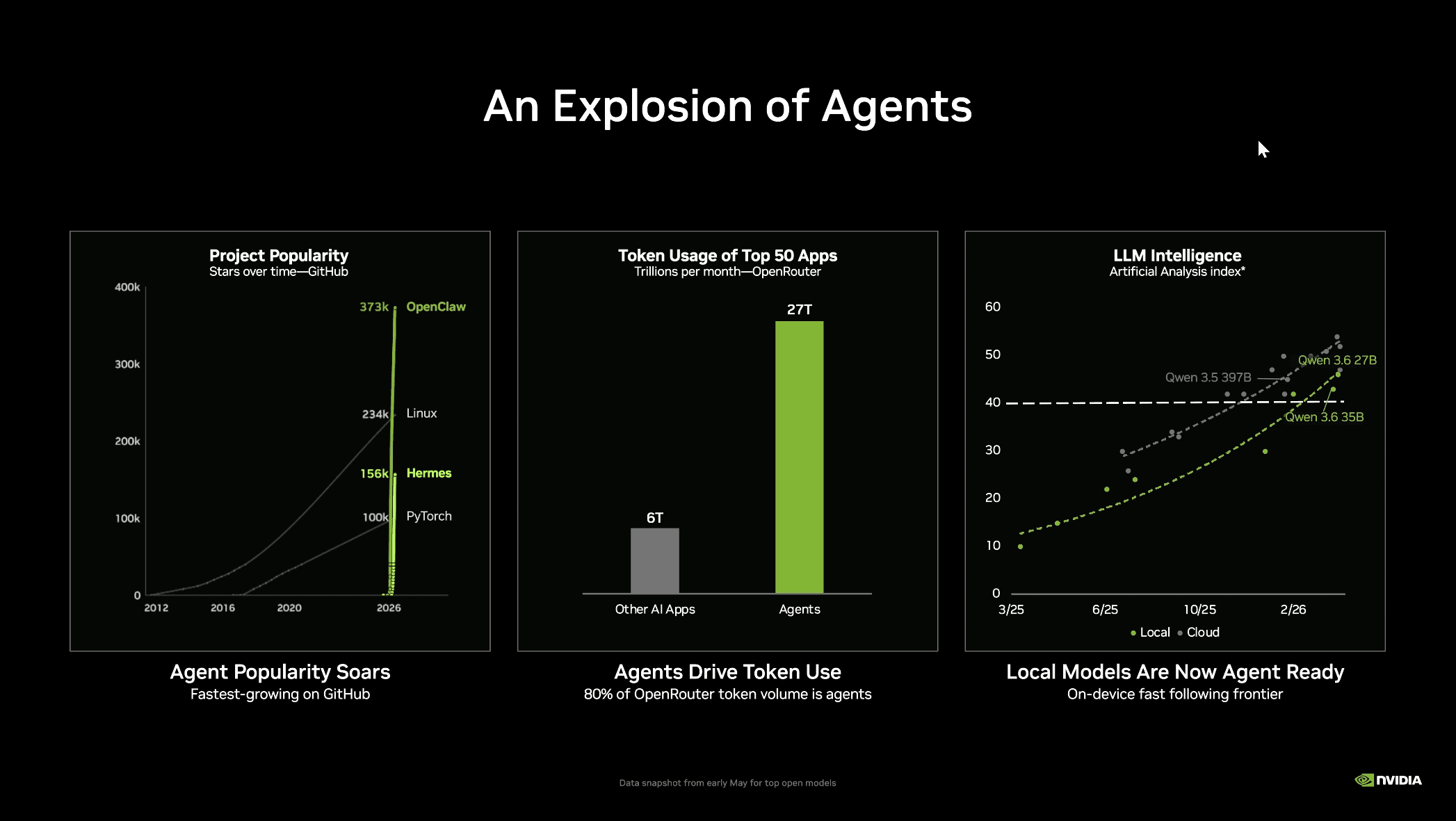
According to NVIDIA, 2026 marks a major turning point for Agentic AI. With open-source AI Agent projects such as OpenClaw and Hermes gaining momentum and large language models continuing to advance, AI Agents are evolving from experimental concepts into practical tools.
For decades, personal computing has revolved around keyboards, mice, and graphical user interfaces. Whether editing videos, creating content, or managing documents, users have traditionally needed to learn complex software workflows to accomplish their goals.
NVIDIA believes AI Agents will fundamentally change that relationship. Rather than navigating menus and learning application-specific tools, users will be able to communicate naturally through text, voice, camera input, or even on-screen content. AI Agents will then autonomously plan workflows, execute tasks across multiple applications, and maintain contextual memory over time.
In NVIDIA's vision, AI will no longer simply be a tool, it will become the new user interface. Agents will understand intent, proactively assist users, and continue working even after the user leaves the computer, functioning as true digital collaborators.
NVIDIA and Microsoft Partner on a Local AI Agent Platform
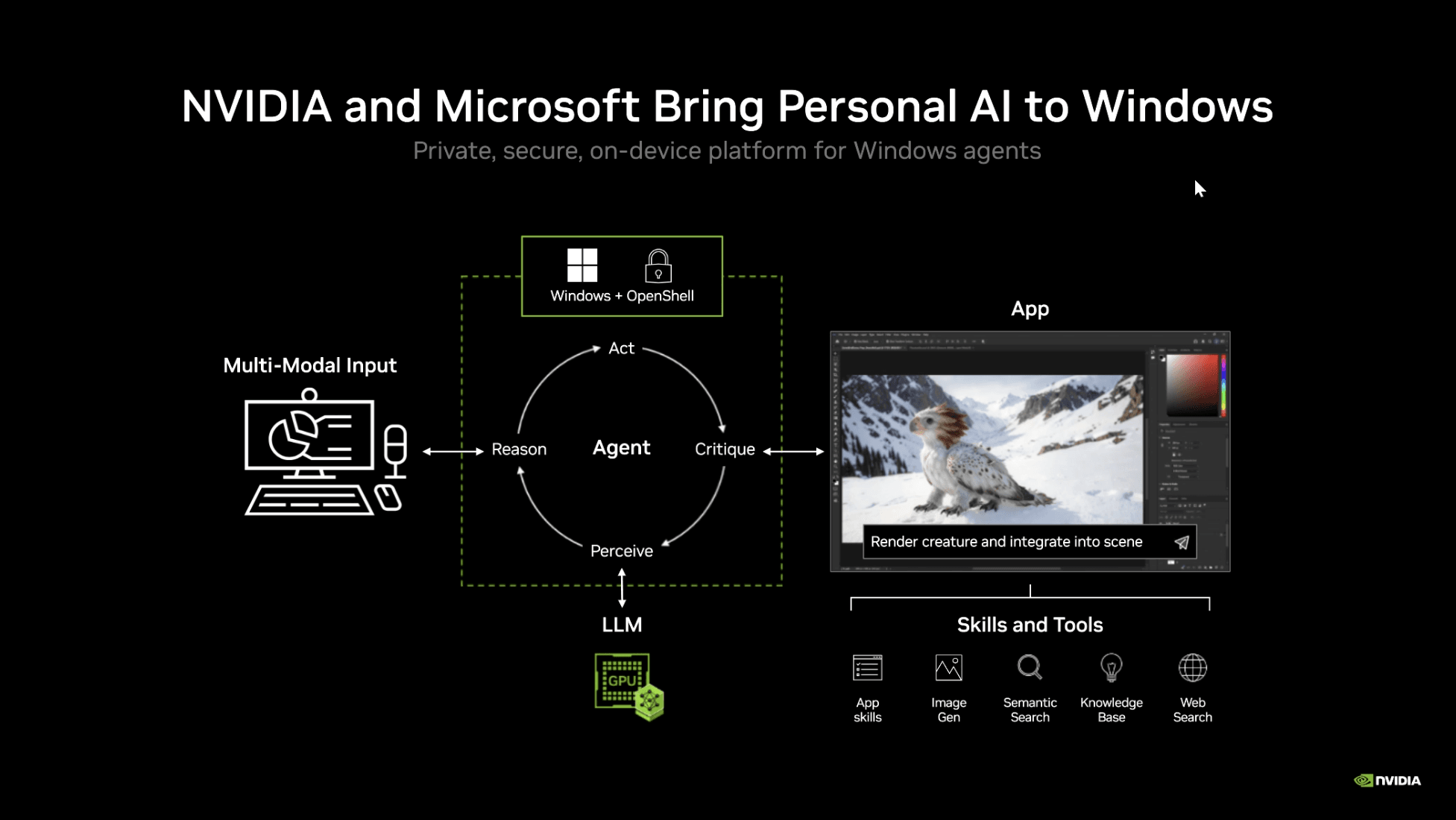
To bring AI Agents safely into the PC environment, NVIDIA announced a deep partnership with Microsoft to develop a new Windows Agent runtime platform.
The initiative combines Microsoft's upcoming Windows Security Primitives with NVIDIA's OpenShell Runtime. Together, the companies aim to create a framework that balances security, privacy, and user control while allowing AI Agents to operate locally on personal devices.
Users will be able to determine which files and folders Agents can access, what system resources they may utilize, and which workloads should run locally versus in the cloud. OpenShell can even automatically obscure sensitive information before any data is transmitted externally, helping protect personal privacy.
According to NVIDIA, strong security and privacy protections are essential if AI Agents are to become trusted assistants for everyday computing.
Accelerating Local AI Agent Performance
Beyond security, NVIDIA is investing heavily in the infrastructure required to run AI Agents efficiently on consumer hardware.
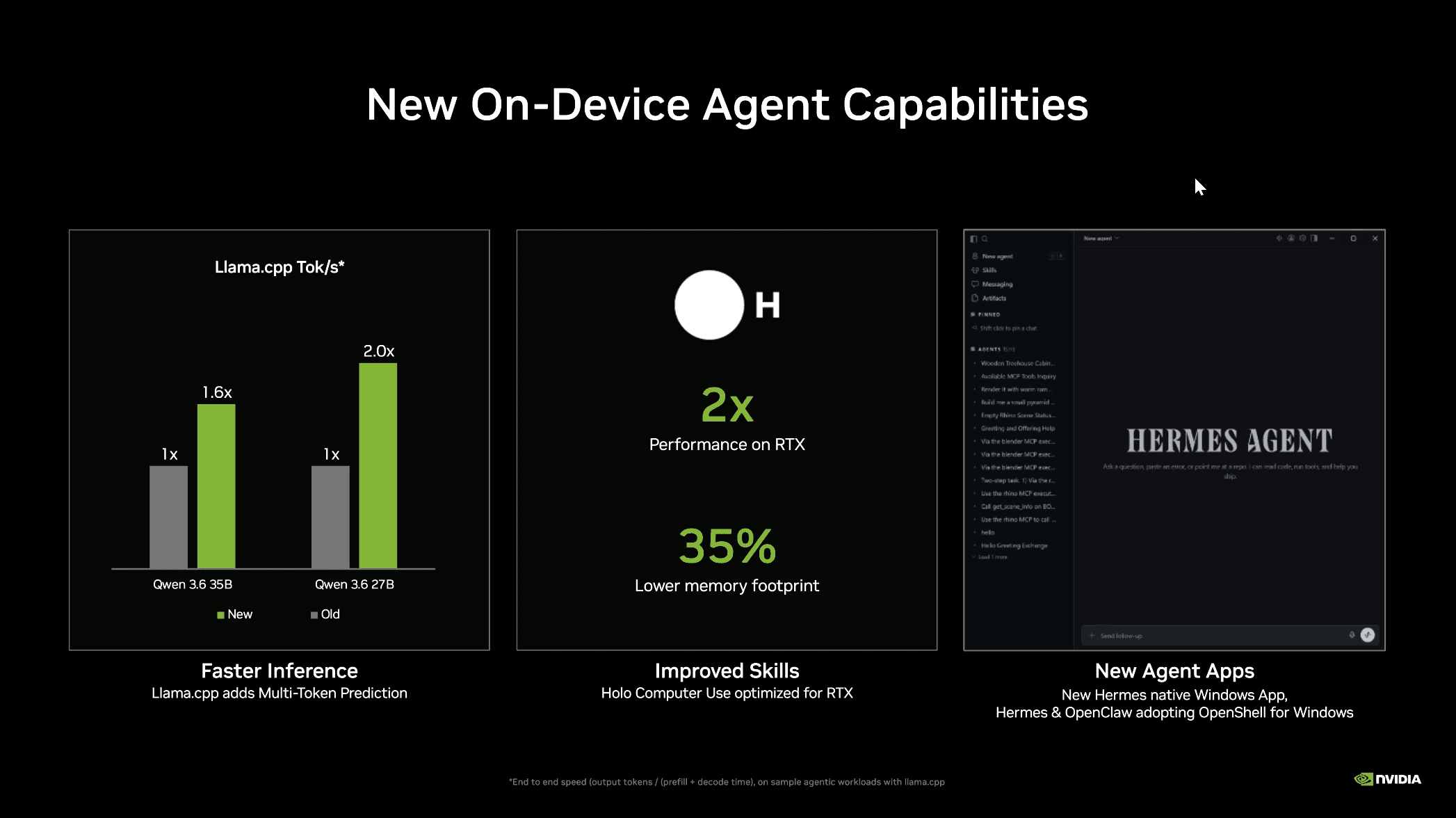
One major collaboration involves the Llama.cpp team and the implementation of Multi-Token Prediction (MTP) technology. Traditional large language models generate one token at a time, while MTP uses a smaller predictive model to anticipate multiple future tokens before the primary model validates them.
NVIDIA claims the technology can deliver up to 2x performance improvements for dense models and approximately 1.6x acceleration for Mixture-of-Experts architectures while maintaining output quality.
The company also partnered with AI startup H Company to optimize its Halo Computer Use model for RTX hardware. Halo allows AI Agents to visually interpret screen content and interact with software using virtual mouse and keyboard inputs. NVIDIA reports that Halo achieves roughly twice the execution speed while reducing memory usage by around 35% on RTX GPUs.
Meanwhile, the popular AI Agent platform Hermes announced a native Windows application that will integrate directly with OpenShell and Microsoft's security framework, making AI Agents more accessible to mainstream users.
AI Agents for Creators, Developers, and Gamers
NVIDIA showcased numerous practical use cases for AI Agents across creative workflows, software development, and gaming.
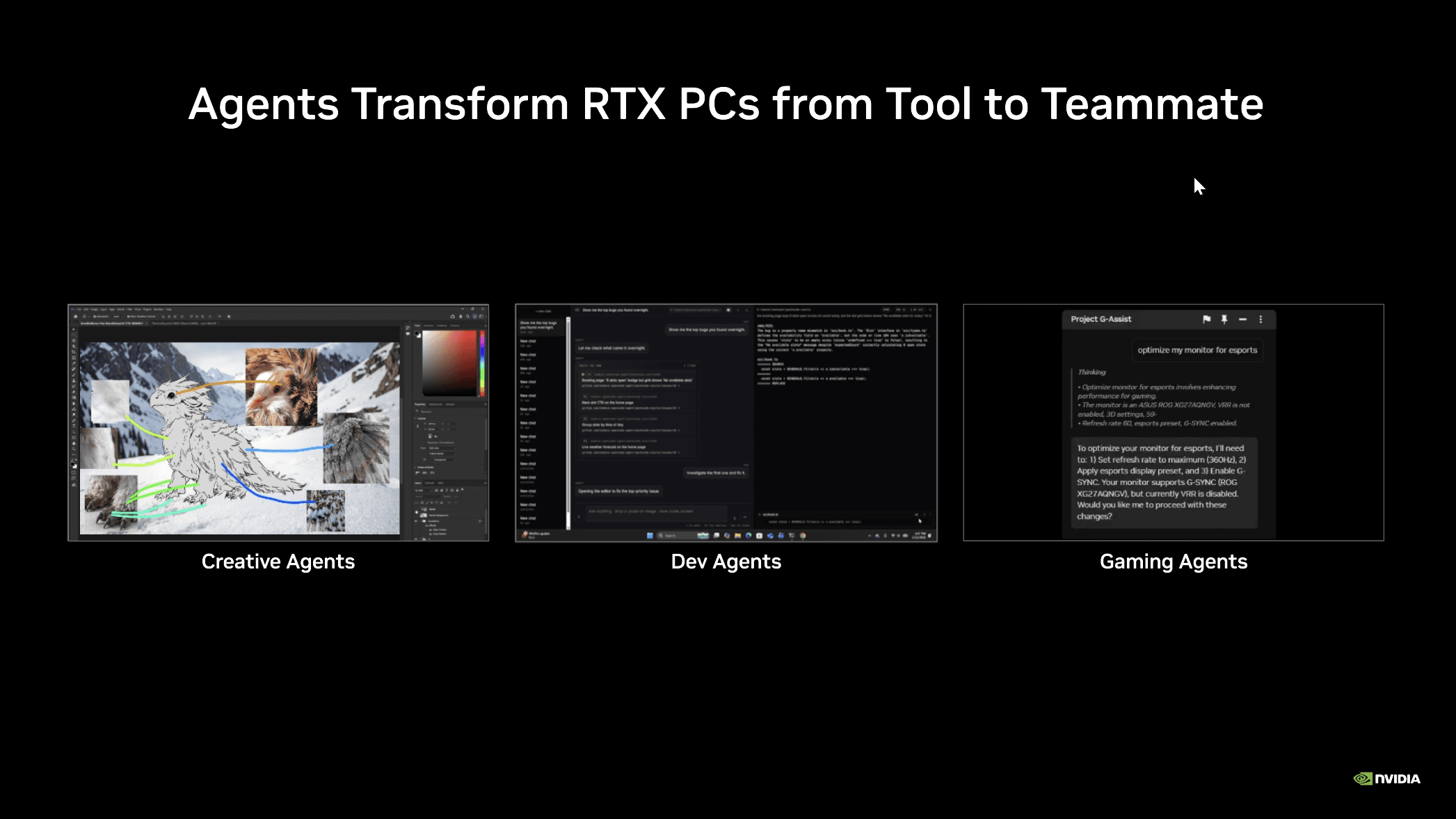
For creators, AI Agents can function as production assistants capable of building and executing complex generative AI workflows. Users can provide sketches, reference images, or simple instructions, while Agents automatically select models, configure workflows, and generate content behind the scenes.
Software development is another area NVIDIA sees as a major opportunity. AI Agents can monitor repositories, analyze bug reports, recommend fixes, and even perform portions of QA testing, allowing developers to focus primarily on review and decision-making.
In gaming, NVIDIA highlighted applications such as G-Assist. Future AI assistants will be capable of adjusting monitor settings, optimizing system performance, managing streaming scenes, and handling other routine tasks through natural language commands.
RTX Spark: A New Superchip Built for the AI Agent Era
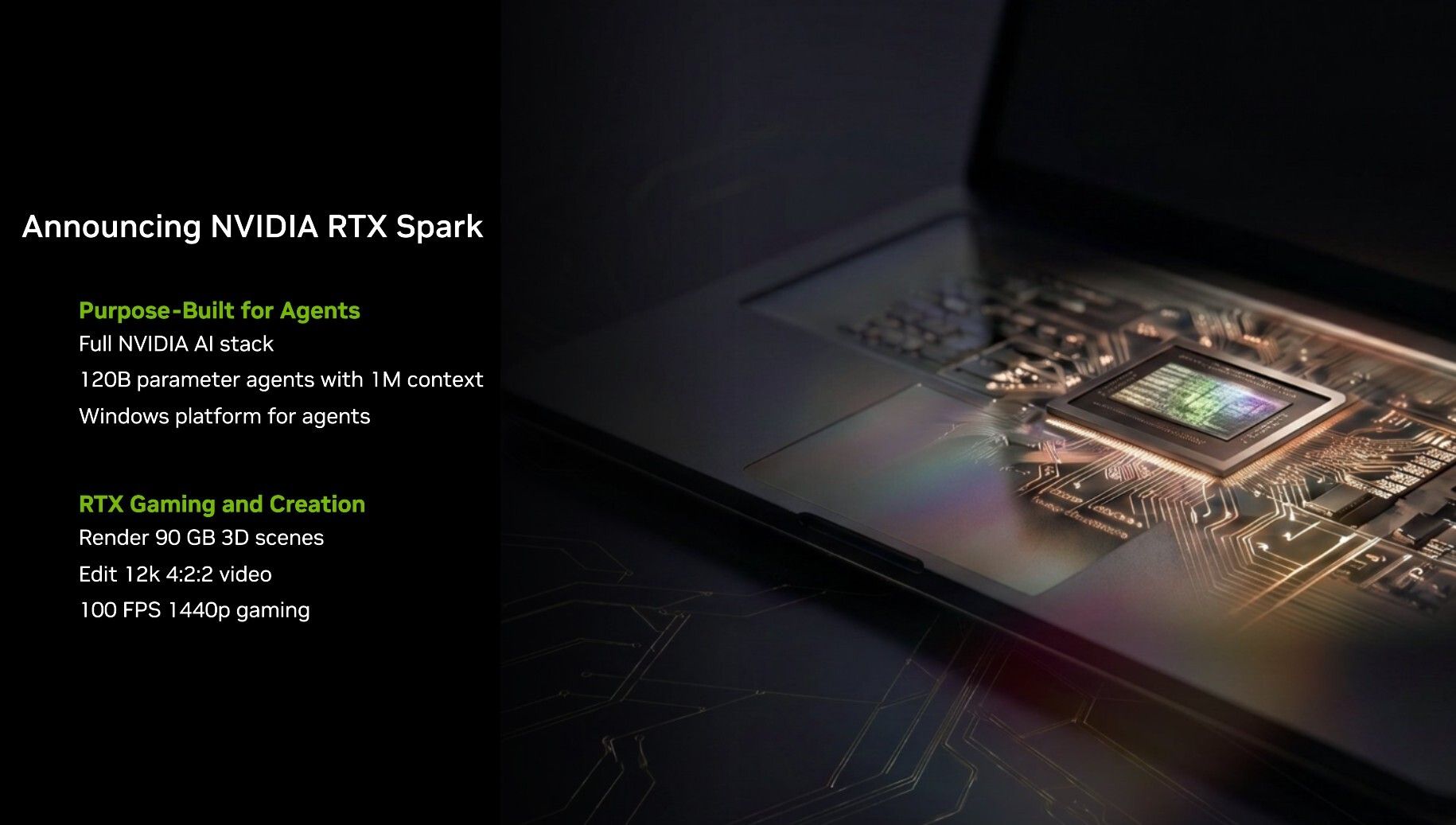
The centerpiece of NVIDIA's announcements was the new RTX Spark Superchip.
CEO Jensen Huang described RTX Spark as "the most efficient PC chip ever built," positioning it as a computing platform designed specifically for the AI Agent era.
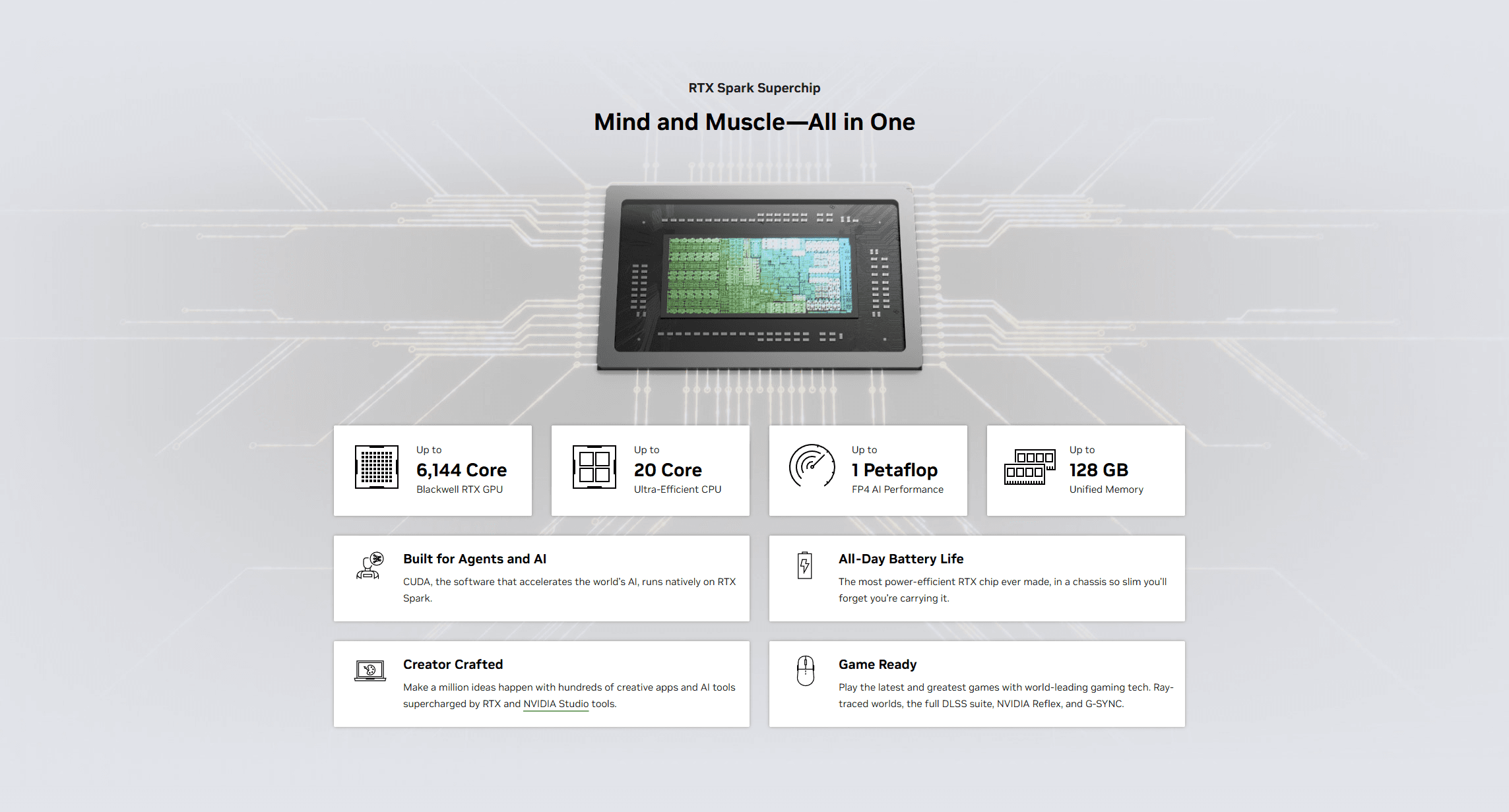
RTX Spark features a new SoC architecture that combines NVIDIA's Blackwell GPU, Grace CPU, and a custom platform developed alongside MediaTek into a single package. The chip contains 70 billion transistors, 6,144 CUDA cores, and a 20-core Grace CPU, delivering up to 1 PFLOP of FP4 AI computing performance.
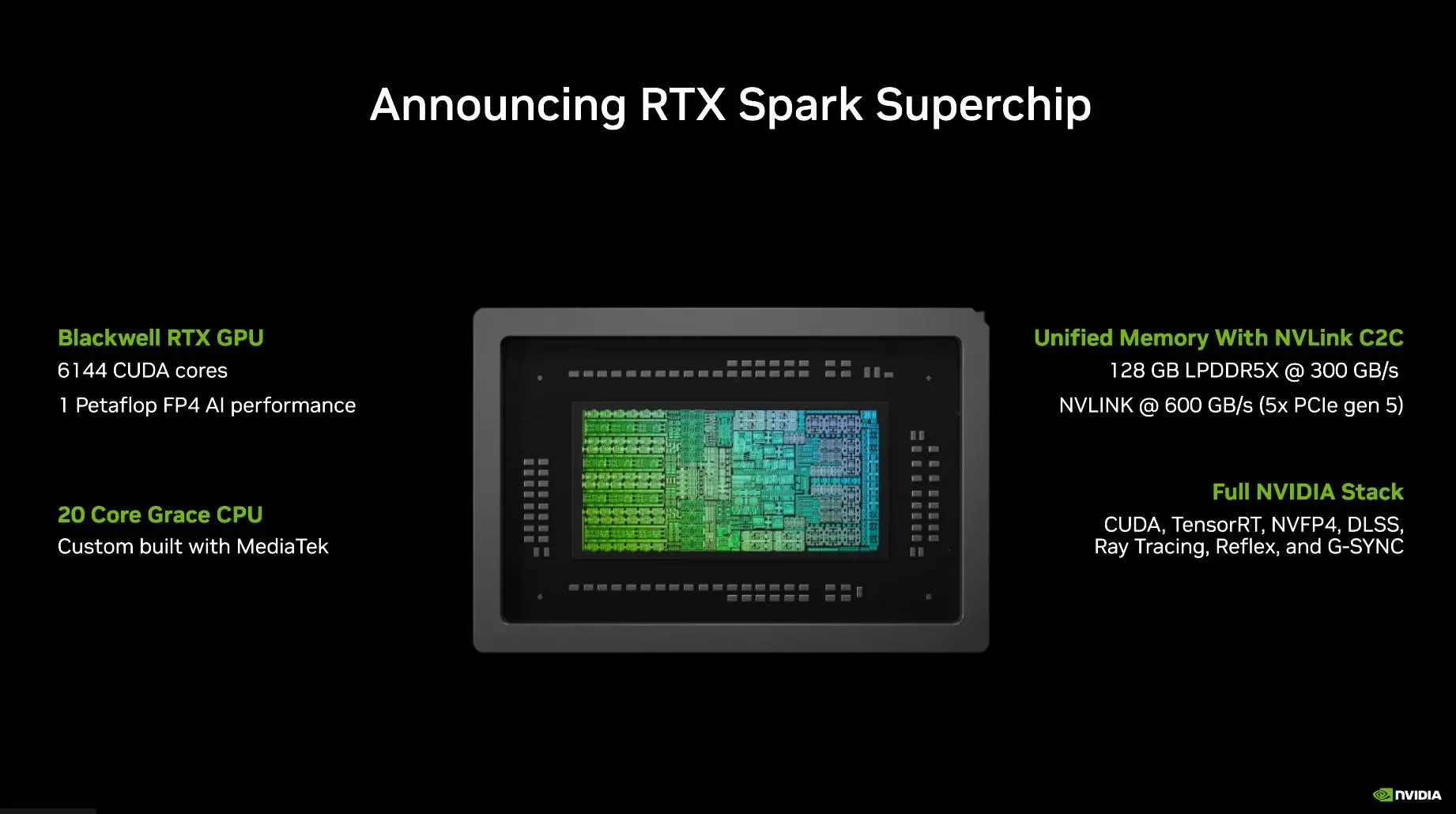
To support large AI models and demanding creative workloads, RTX Spark supports up to 128GB of unified memory and 300GB/s of memory bandwidth. NVIDIA's NVLink-C2C interconnect further enables data transfer speeds of up to 638GB/s.
NVIDIA claims overall performance rivals that of a GeForce RTX 5070 Laptop GPU while offering significantly greater power efficiency.
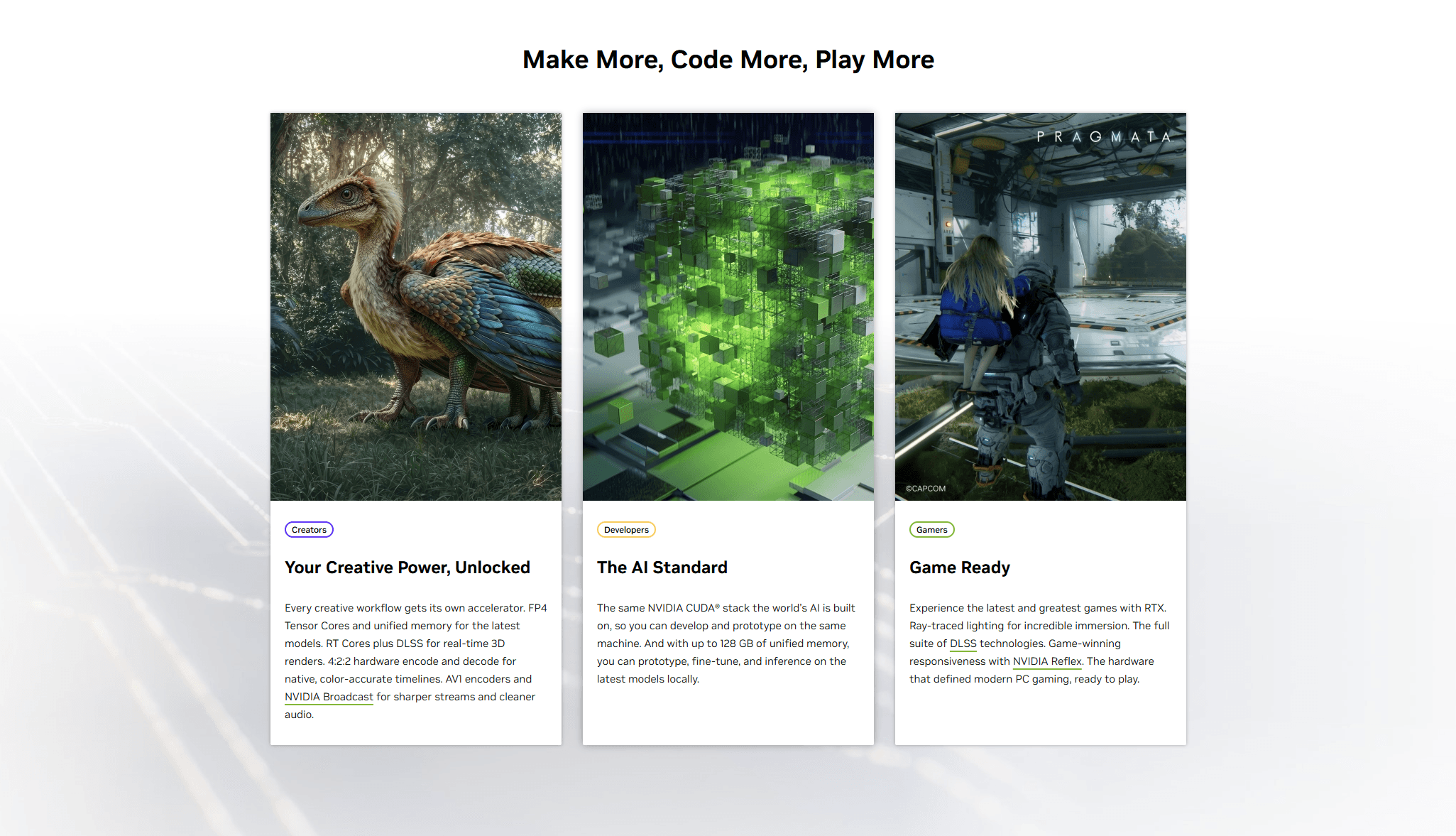
As a member of the RTX family, Spark fully supports CUDA, TensorRT, DLSS, RTX ray tracing technologies, and NVIDIA's broader AI software ecosystem, making it suitable for AI, content creation, and gaming alike.
A Major Leap Forward for Windows on ARM
RTX Spark also represents NVIDIA's biggest push yet into high-performance Windows on ARM computing.
To ensure software readiness, NVIDIA is working closely with developers including Adobe, Blender, DaVinci Resolve, CapCut, and ComfyUI. The company has also optimized popular AI frameworks and tools such as PyTorch, Hugging Face, Llama.cpp, Ollama, LM Studio, and Unsloth.
For gaming, NVIDIA is collaborating with developers behind titles including Fortnite, Valorant, League of Legends, and PUBG to deliver optimized experiences on Windows on ARM devices. Partnerships with Easy Anti-Cheat, BattlEye, and Denuvo aim to address compatibility challenges for online games running on ARM-based platforms.
Adobe Rebuilds Premiere Pro and Photoshop for RTX Spark
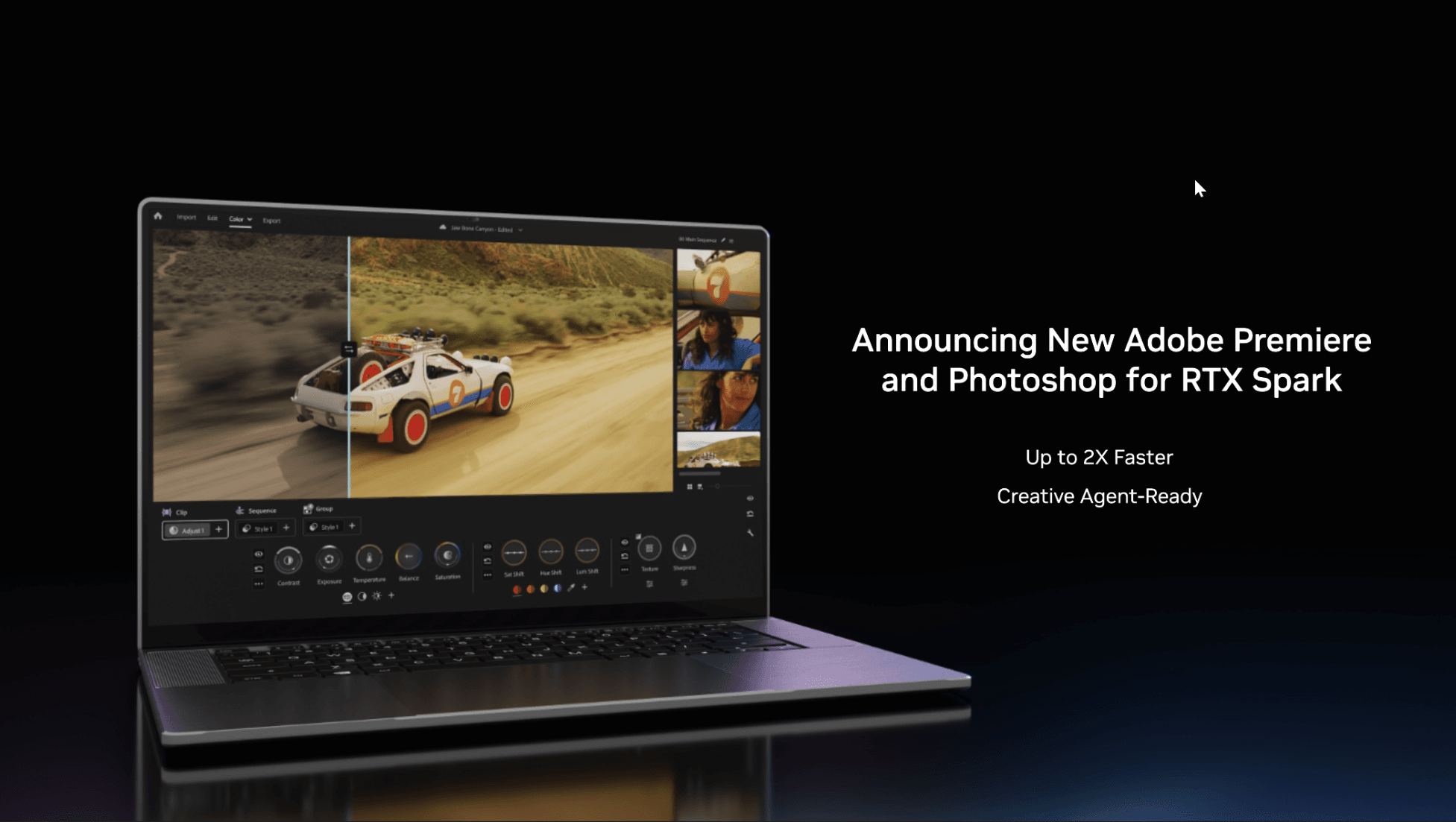
Adobe emerged as one of NVIDIA's most significant partners during the presentation.
The company is reportedly performing extensive architectural redesigns of Premiere Pro and Photoshop to fully leverage RTX Spark hardware.
Premiere Pro will take advantage of unified memory, Blackwell GPU acceleration, and Tensor Core AI capabilities to improve editing responsiveness, color grading, AI-powered effects, and high-resolution timeline performance.
Photoshop is also moving beyond limited GPU acceleration toward a nearly fully GPU-driven processing architecture.
Adobe is additionally adopting MCP (Model Context Protocol), enabling future AI Agents to directly interact with Premiere Pro and Photoshop through natural language commands for content generation, editing, and modification.
Blender and RTX Video Receive New AI Enhancements
NVIDIA also announced that Blender 5.3 will introduce DLSS Ray Reconstruction support.
The new AI-powered technology allows artists to preview path-traced scenes at significantly higher quality while reducing denoising wait times and accelerating production workflows.
Meanwhile, RTX Video is gaining AI Frame Generation capabilities. Since many generative video models still produce relatively short clips at limited frame rates, AI-generated intermediate frames can improve smoothness and effectively extend usable content. NVIDIA plans to bring the feature to ComfyUI later this year.
DLSS 4.5 Ray Reconstruction Officially Revealed
For gamers, NVIDIA introduced DLSS 4.5 Ray Reconstruction.
Built on a second-generation Transformer architecture, the new model features approximately 20% more parameters while improving computational efficiency by roughly 35%, all while maintaining performance levels comparable to previous implementations.
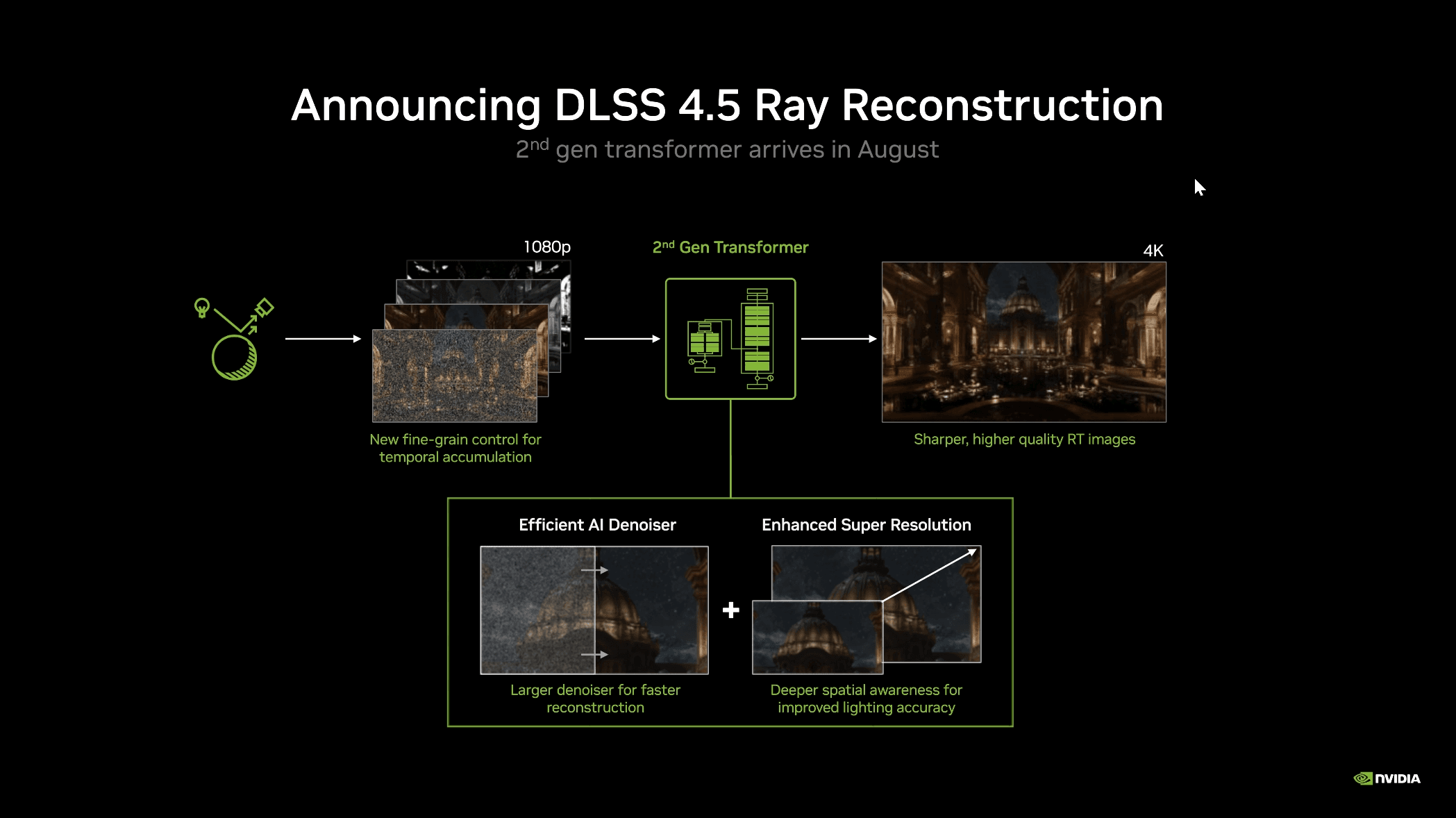
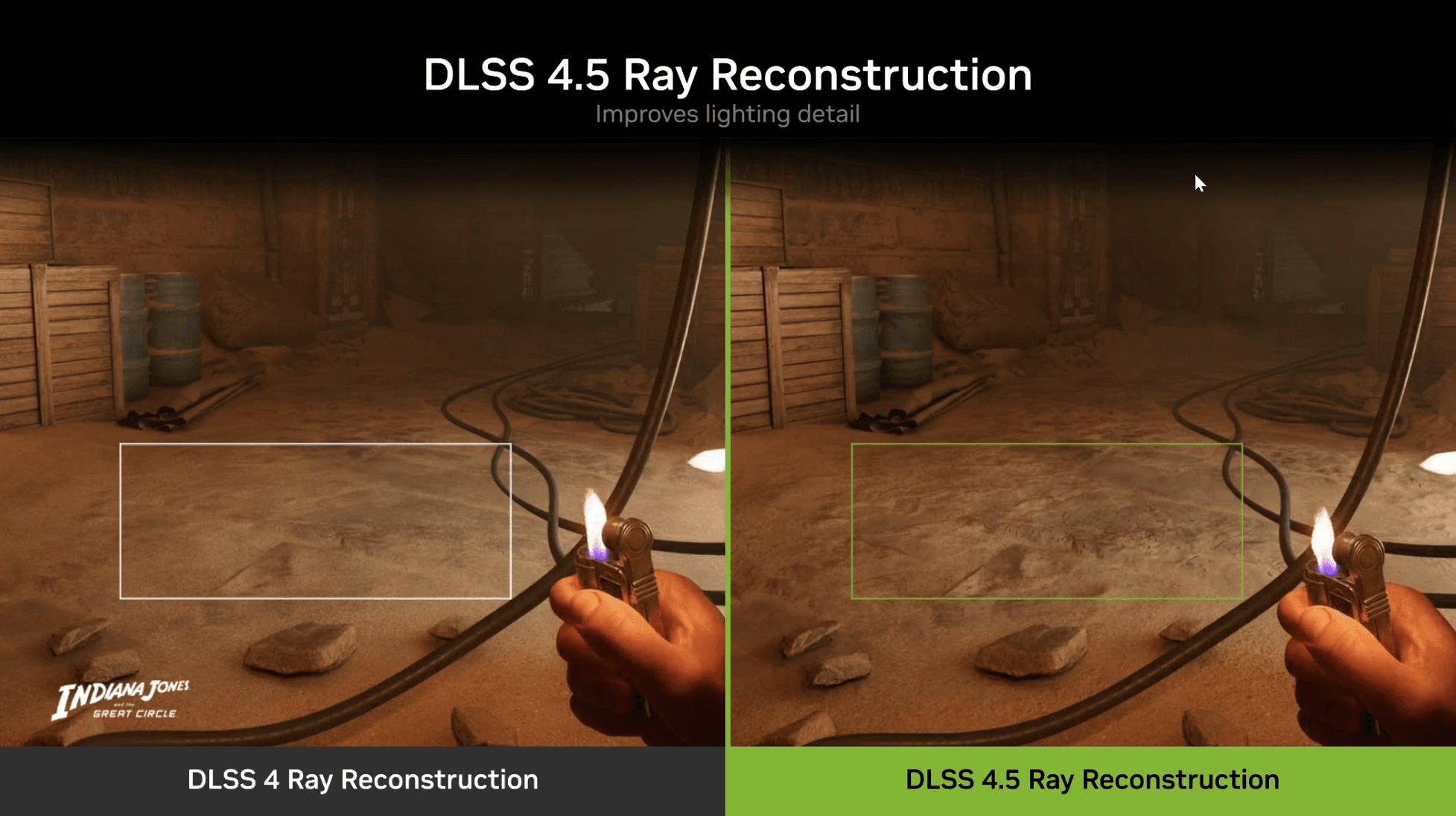
Compared to traditional ray-tracing denoisers, DLSS 4.5 can more accurately analyze spatial and temporal data, resulting in improved reflections, sharper shadows, enhanced detail retention, and better image stability.
NVIDIA demonstrated the technology using Alan Wake 2, Indiana Jones and the Great Circle, and Pragmata, showcasing significant improvements in image quality, lighting fidelity, and ghosting reduction.
DLSS 4.5 Ray Reconstruction is scheduled to launch this August and will support RTX Spark as well as all RTX GPUs.
RTX Spark Launches This Fall
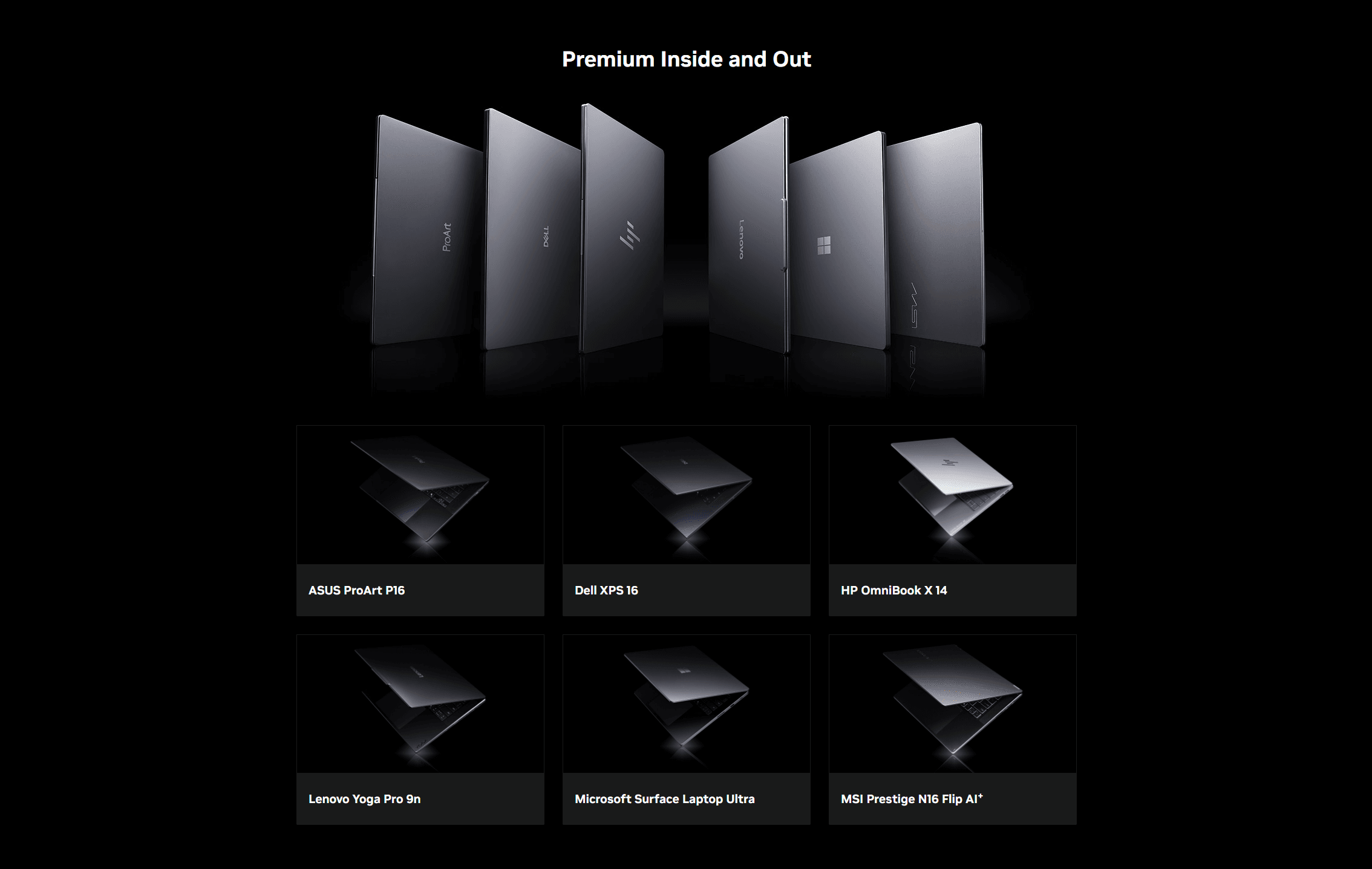
NVIDIA confirmed that the first wave of RTX Spark laptops will be released by ASUS, Dell, HP, Lenovo, Microsoft, and MSI, including models from the ProArt, XPS, OmniBook, Yoga Pro, Surface Ultra, and Prestige product families.
These systems will emphasize thin-and-light designs, powerful AI performance, all-day battery life, OLED displays with high color accuracy, and G-SYNC support. Some models are expected to be as thin as 14mm and weigh around three pounds.
Desktop systems powered by RTX Spark will also arrive from Acer, ASUS, Dell, HP, Lenovo, MSI, and Gigabyte, targeting users running AI Agents and other demanding workloads continuously.
From local AI Agent platforms and the RTX Spark Superchip to Adobe's software transformation and DLSS 4.5 graphics technologies, NVIDIA's entire presentation revolved around a single vision: making AI Agents the central computing experience of future PCs.
With RTX Spark laptops and desktops arriving later this year, NVIDIA is clearly aiming to move AI Agents beyond cloud services and into every user's personal device, ushering in the next era of AI-powered computing.