 Slimepress
The Adventures of Elliot: The Millennium Tales Review — Travel Through Four Stunning HD-2D Eras with with Your Fairy in an Unforgettable Epic Adventure
Translated from our Nmia Chinese author Andrew's review article
Asano Team has another HD-2D game?! Well, I say that partly as a joke, but there's no denying the style has become increasingly common in recent years. That's exactly why the most interesting thing about The Adventures of Elliot: The Millennium Tales isn't that it's another HD-2D RPG, it's that Asano Team is pushing the formula into action RPG territory.
When people think of HD-2D, games like Octopath Traveler and Triangle Strategy usually come to mind. Elliot, however, takes a very different approach. Instead of navigating menus and planning turns, you'll be swinging swords, jumping across platforms, swapping weapons, and freely exploring the world in real time.
That immediately gives the game a fresh identity. It still has everything that makes HD-2D special, pixel-art characters, beautiful lighting, detailed environments, and that nostalgic Super Nintendo-era charm. But once you start playing, it feels far closer to a modern action RPG than a traditional turn-based adventure.
After spending roughly 60 hours with the game, I came away feeling that its biggest strength isn't simply turning HD-2D into an action game. It's how successfully it combines real-time combat, exploration, time-travel storytelling, and character progression into something that feels both familiar and new.
Of course, the transition won't work for everyone. Players who prefer the slower, more strategic pace of Octopath Traveler may need some time to adjust. But because the game treats HD-2D as more than just a visual style, Elliot and Faie's adventure ends up feeling refreshingly different from anything Asano Team has done before.
For me, The Adventures of Elliot: The Millennium Tales is one of Square Enix and Asano Team's boldest HD-2D experiments yet, and ultimately my favorite HD-2D game from the studio to date.
Title: The Adventures of Elliot: The Millennium Tales
Developer: Square Enix, Claytechworks
Publisher: Square Enix
Platform: PlayStation 5, Xbox Series X|S, Nintendo Switch 2, PC
Release Date: June 19, 2026

The Story and World of The Adventures of Elliot: The Millennium Tales
As the title suggests, The Adventures of Elliot: The Millennium Tales is exactly what it sounds like, a grand fantasy adventure that follows the explorer Elliot across a thousand years of history. In many ways, the title tells you everything you need to know about the game's premise. That said, I'll be honest, it's also a bit of a mouthful to remember. Asano Team makes fantastic games, but naming them has never really been their strongest suit.
The story itself follows a fairly classic fantasy adventure structure. Players take on the role of Elliot, who sets out on a journey alongside his fairy companion Faie to break the curse afflicting Princess Heria of the Kingdom of Huther. To uncover the truth behind the curse, the duo must travel through a mysterious time gate and journey across four vastly different eras: the Age of Safekeeping, where Elliot's own story begins; the Age of Reconstruction, where humanity teeters on the brink of extinction; the Age of Magic, a prosperous civilization built upon the power of magic; and the Age of Budding, an ancient era inhabited by the world's primordial races.
Even from the outset, these four eras provide a clear foundation for the adventure. Each period has its own identity, history, and atmosphere, giving the journey a strong sense of progression as Elliot and Faie travel across time in search of answers.

While The Adventures of Elliot doesn't tell a particularly dark or genre-defying story, its greatest strength lies in how well it incorporates the concept of time travel into the world itself. Rather than simply moving from one map to another, you'll constantly travel between different eras and witness how the same locations evolve over centuries. A barren wasteland in one age may become a thriving city in another, while the enemies, ecosystems, and overall atmosphere shift alongside the passage of time.
As a result, the world feels alive and ever-changing, giving the adventure a genuine sense that history is unfolding before your eyes.
The game's multi-era structure also introduces a wide variety of characters throughout the journey, once again highlighting Team Asano's strength in character design. From key figures whose fates become intertwined with Elliot and Faie, to the many NPCs scattered across different eras, these encounters add warmth and personality to the adventure.
Not every character receives extensive development, but each carries their own background, motivations, and connection to the era they inhabit. Together, they help transform the journey from a simple hero's quest into a sprawling tale that spans generations, gradually building a world that feels rich, lived-in, and connected across a thousand years of history.

The game also includes plenty of side quests. To be honest, some still lean toward traditional fetch-quest design, mainly serving as a way to earn extra rewards, resources, or encourage exploration. However, quite a few of them do a good job of fleshing out the world, giving players a better look at the people and everyday lives across each era. They may not all be memorable, but they help make the world feel more alive and worth exploring beyond the main story.
That said, the multi-era structure does come with one noticeable drawback: the pacing can feel a little slow at the start. Since the game needs to establish four different eras, their histories, characters, and worldbuilding, it takes some time before the larger story really comes together. It's not a deal-breaker, and honestly it's hard to avoid in a story of this scale, but players expecting immediate drama may find the opening hours a bit slow-burning.
The game features three different endings, allowing this thousand-year adventure to conclude in different ways. While the overall story follows a fairly traditional fantasy formula, there are still a few surprising twists along the way. Unfortunately, the slow start may make it harder for some players to stay invested before the narrative fully hits its stride.
One area where the game consistently shines, however, is its presentation. Team Asano once again makes excellent use of HD-2D's lighting, environmental depth, and cinematic camera work to bring story scenes to life. Rather than relying solely on dialogue, many moments are enhanced through clever framing and visual storytelling, helping the world feel more immersive even during quieter narrative sequences.

Time-travel stories have always been one of Square Enix's strengths. Whether it's the timeless adventure of Chrono Trigger or the way Dragon Quest VII uses the past to reshape the future, the company has built some truly memorable experiences around the idea of traveling across eras. That's one of the reasons I was especially excited for The Adventures of Elliot, to see whether it could carry on that tradition while carving out its own identity as an HD-2D action RPG.
Overall, the story isn't trying to win players over with shocking twists or constant surprises. Instead, it builds around its central theme of a journey spanning a thousand years, tying together adventure, changing eras, memorable encounters, and world exploration. The opening hours can be a little slow, and some side quests still feel fairly routine, but the constantly evolving world, the characters you meet along the way, and the strong sense of adventure created by the game's HD-2D presentation give the journey plenty of charm.
For me, it's not a groundbreaking story, but it's a solid and effective foundation for the kind of long-form action RPG adventure the game wants to be.

World Exploration and Dungeon Design of The Adventures of Elliot: The Millennium Tales
At first glance, the world design of The Adventures of Elliot feels reminiscent of other Team Asano games, particularly the overworld-style exploration seen in titles like Octopath Traveler 0. The biggest difference, however, is that there are no random encounters this time. Since the game is a full action RPG, enemies appear directly on the map, allowing players to see where they are and decide whether to engage. It makes exploration feel much smoother, especially compared to constantly being interrupted by battles every few steps.
Of course, enemies don't stay gone forever. They gradually respawn over time, ensuring the world never feels empty after you've cleared an area. It's a small but important detail that helps maintain a sense of danger and keeps exploration from becoming too routine.
The overworld is also dotted with save points that act as checkpoints throughout your journey. They are somewhat similar to bonfires in Soulslike games, though not identical in function. Rather than simply serving as respawn points, they record your progress and determine where you'll return after death. The nice part is that saving happens automatically whenever you pass one, so there's no need to manually interact with them every time. As a result, activating new save points naturally becomes one of your early exploration goals, giving the adventure a clear and satisfying sense of progression.

What really makes the level design stand out, however, are the indoor dungeons scattered throughout the world. These dungeons are easily one of game's biggest highlights. Since the game shifts from a traditional RPG to an action RPG, Elliot isn't limited to attacking and dodging, he can jump as well.
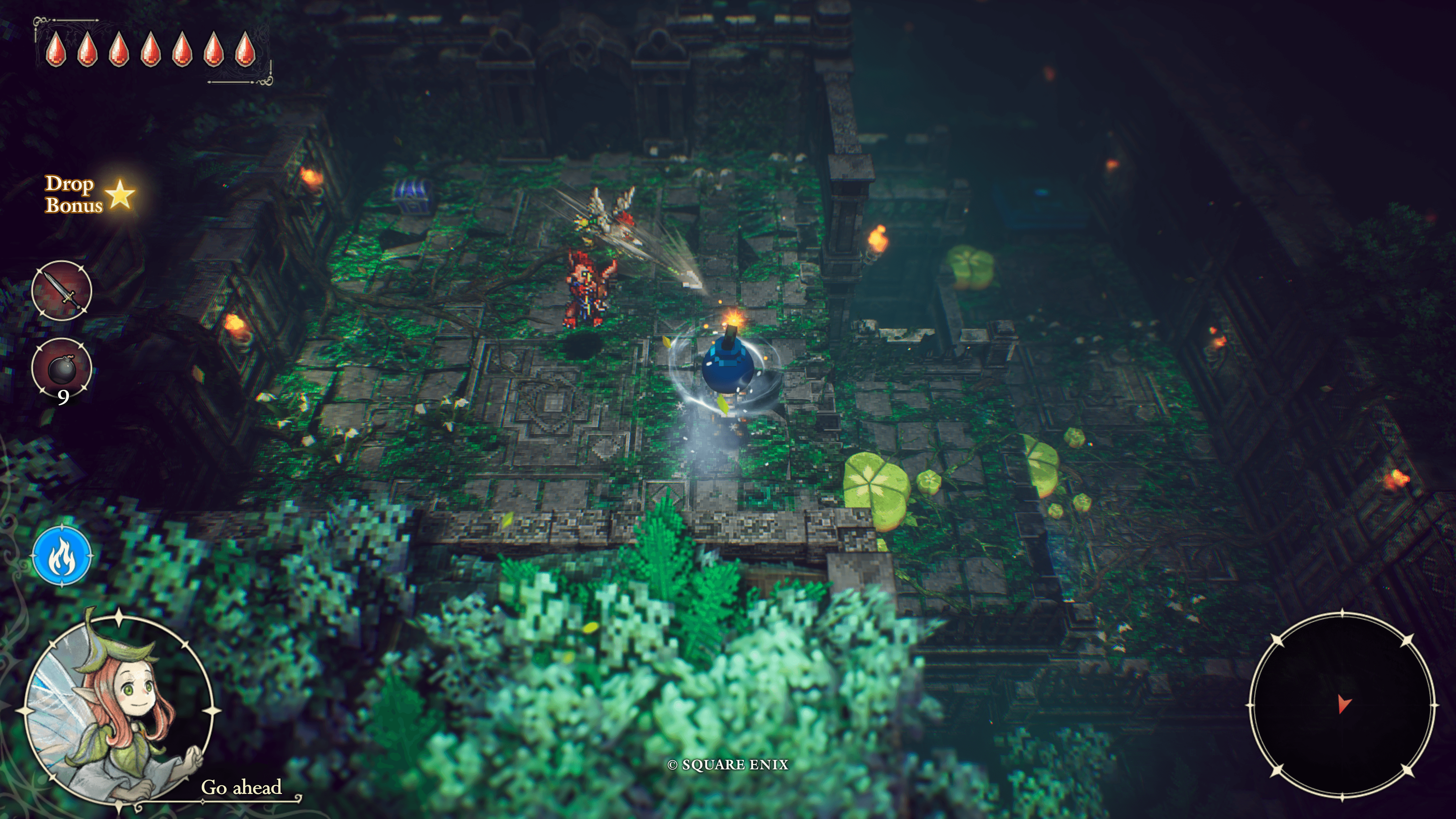
That may sound like a small change, but it has a huge impact on how exploration works in an HD-2D game. Dungeons are no longer just about walking down corridors, opening doors, and collecting treasure. Instead, they incorporate platforming, vertical level design, and route-finding, making exploration feel far more dynamic. Thanks to the combination of 2D gameplay and HD-2D's layered environments, you'll often find yourself fighting enemies, navigating platforms, and searching for hidden paths at the same time.
You'll constantly be paying attention to elevation changes, enemy placements, treasure chests, and suspicious areas that seem unreachable for the moment. As a result, exploration feels much closer to an action-adventure game than a traditional dungeon crawl. The platforming challenges are rarely punishing, but when combined with real-time combat and varied terrain, they add a welcome layer of variety to the overall pacing.

Another important design choice is the game's fixed camera perspective. Many action-platformers require players to constantly adjust the camera, but The Adventures of Elliot keeps it fixed, allowing players to focus on combat, exploration, and platforming instead. For an HD-2D action RPG, this feels like the right call. Not only does it reduce unnecessary camera management, but it also allows the game's visuals, level layouts, and environmental depth to shine more consistently.
Exploration is also driven by meaningful rewards. Let's be honest, half the reason we explore in games like this is to find treasure chests, right? Thankfully, the rewards here are worthwhile. Chests can contain currency, upgrade materials, equipment, permanent health upgrades, and other resources that directly impact character progression. That makes a huge difference because it means you're not exploring just to fill out the map, you're exploring because there's a good chance you'll find something genuinely useful.
As a result, whenever you spot a treasure chest sitting on a distant ledge or hidden corner of the map, your immediate reaction is usually, "Okay, how do I get over there?" That's exactly the kind of curiosity a good exploration-focused adventure game should inspire.

Beyond treasure chests, the game also includes a surprisingly charming collectible: cats scattered throughout the world. You can buy food to feed them and even interact with them using toys, which makes me think there must be at least a few cat lovers on the development team.
That said, I have no idea what those cats were fed before recording their voice lines though. Some of their meows are so over-the-top that they can be unintentionally hilarious and occasionally pull you out of the moment. Still, quirky voice acting aside, these little feline encounters add a welcome touch of personality to the world and help make it feel a bit more lived-in.

What impressed me most about the game's world design, however, was how dramatically locations change across different eras. This ties directly into the game's time-travel premise. As players journey between multiple periods, the same locations can look completely different depending on when you visit them. While the idea of revisiting a place across different points in history isn't exactly new, seeing it realized through the HD-2D presentation gives it a surprising amount of impact. More importantly, the game isn't simply comparing two timelines, it constantly sends players across several distinct eras, making the world feel far richer and more layered.
One of my favorite moments was returning to familiar locations and seeing just how much they had changed. The main city is probably the best example. What begins as a relatively modest royal capital eventually transforms into a ruined wasteland during the Age of Reconstruction, before later evolving into a massive and thriving metropolis during the Age of Magic. Watching those transformations unfold is genuinely fascinating. It's not just a matter of swapping out enemies or changing the scenery, it gives you a real sense of how history has shaped each place and what it has become over the centuries.

What's even more interesting is that some changes carry across eras. Shortcuts you've unlocked, routes you've opened, and even certain treasure-related elements can appear differently when you revisit the same location in another age. I wasn't expecting a full immersive-sim level of cause and effect, where every action dramatically reshapes the future, but the game does feature puzzles and progression mechanics that require you to perform specific actions in one era to unlock paths in another. The idea isn't particularly complex, but it makes excellent use of the time-travel concept and gives revisiting familiar locations a real sense of purpose.
Overall, The Adventures of Elliot: The Millennium Tales does an impressive job blending HD-2D visuals, action-focused exploration, platforming, and time-spanning world design. The overworld feels more engaging without random encounters, the dungeons benefit greatly from jumping mechanics and Faie's abilities, and seeing familiar locations transformed across different eras remains one of the game's biggest highlights. Combined with worthwhile treasure rewards, exploration constantly encourages you to wander a little farther, look a little closer, and check just one more corner before moving on.

HD-2D Meets Real-Time Action Combat in The Adventures of Elliot: The Millennium Tales
The most immediate difference in The Adventures of Elliot is undoubtedly its combat system. For the first time, an HD-2D game from Team Asano fully embraces real-time action combat, leaving behind the turn-based formula that defined games like Octopath Traveler. It's a bold move, and one that will naturally divide some players. If you're someone who enjoys carefully planning turns, exploiting weaknesses, and thinking several moves ahead, the shift to action combat may take some getting used to.
If you're willing to embrace that change, however, the combat quickly reveals its own strengths. The biggest highlight is the variety offered by the game's seven weapon types. Elliot can wield swords, war hammers, chain weapons, bows, firearms, spears, and boomerangs, and each one feels genuinely distinct rather than a simple cosmetic swap. Their attack ranges, rhythms, and overall playstyles differ noticeably, and each weapon comes with two attack variations, giving players plenty of flexibility to adapt to different enemies and situations.
As a result, combat rarely feels one-note. Whether you prefer fighting up close, attacking from range, or constantly switching between different approaches, the game gives you enough options to find a playstyle that suits you. That's what makes the action combat work so well, it doesn't just replace the old turn-based system, it creates a new identity of its own.

The differences between weapons are what make the combat so enjoyable. The boomerang, for example, is great for keeping enemies at a distance. After charging it up, you can throw it out and let it hover in place, continuously damaging enemies while you stay safely out of harm's way. Chain weapons strike a nice balance between range and crowd control, making them one of the easier and more forgiving options to use.
Then there's the hammer. At first, it feels slow and awkward, but once you get used to its timing, landing a fully charged hit and watching a huge chunk of an enemy's health disappear becomes incredibly satisfying. Because each weapon has such a distinct feel, combat never boils down to mindlessly attacking enemies. Instead, it gradually encourages players to discover a playstyle that suits them best.
The combat itself also feels surprisingly satisfying. Attacks are responsive, dodges feel snappy, and every successful hit delivers clear feedback. That's not entirely surprising, as Team Asano has always done a good job making their HD-2D games feel impactful, but the shift to real-time combat makes those strengths much more noticeable.
In the past, the excitement came from watching flashy skills play out during turn-based battles. Here, you're the one controlling every swing, dodge, and attack sequence. Being able to personally manage spacing, timing, and combos gives the combat a much more hands-on feel, and honestly, there's something refreshingly unique about experiencing this kind of real-time action through an HD-2D visual style.

The combat does retain one old-school element, however: eight-directional movement. Elliot can only move in the four cardinal directions and four diagonals, much like classic 2D action games. That means positioning and spacing matter a lot more than they would in a typical 3D action RPG. You can't simply rely on camera control or free movement to correct your mistakes. It may feel a little old-fashioned at first, but it also gives combat a distinct retro action-game flavor that fits the HD-2D style surprisingly well.
What's more interesting is how environmental hazards affect combat. Tall grass, ice, lava, and other terrain types can influence movement and positioning, sometimes making fights more challenging than the enemies themselves. There were moments where I found myself cutting down grass before engaging, simply to avoid having my movement speed reduced during battle. It's not an especially deep system, but it does add another layer of decision-making. You're not just thinking about what you're fighting, you're also thinking about where you want to fight.
The game also features a bonus drop mechanic that rewards clean play. As you defeat enemies without taking damage, your bonus multiplier gradually increases, leading to better loot drops. The moment you get hit, however, the bonus resets. It's a simple system, but an effective one. Rather than just focusing on winning fights, it encourages players to fight efficiently and avoid unnecessary mistakes. For anyone who enjoys chasing high rewards and maintaining combat momentum, it adds a little extra tension and excitement to even the most routine encounters.

Of course, because the game has shifted to real-time action combat, it can feel a bit repetitive in the early hours compared to something like Octopath Traveler, where every battle revolves around exploiting weaknesses, managing resources, and planning turns. If you're simply using the same weapon and repeating the same attacks, fatigue can eventually set in.
Fortunately, the game gives players plenty of ways to mix things up. You can equip two weapons at once and freely swap between all seven weapon types through the menu. That flexibility goes a long way toward keeping combat fresh and preventing fights from feeling too repetitive.
As you progress, you'll also find stronger versions of existing weapons. These upgrades don't just increase damage, some unlock enhanced charge attacks that can significantly change how a weapon plays. In that sense, what makes the combat enjoyable isn't simply that it's real-time. It's the variety of weapons and playstyles supporting that system.
Simply put, the best part isn't that you can finally hack and slash enemies in real time, it's that the game gives you a whole toolbox of weapons to experiment with, and each one has its own unique appeal.

When it comes to character progression, The Adventures of Elliot takes a surprisingly different approach. Instead of relying on a traditional leveling system, the game uses a Magicite system that lets players customize their build through equipped stones and their various effects. It's a smart design choice that keeps progression meaningful without forcing players to grind levels. Rather than asking, "What level am I?", the game constantly asks, "How do I want to play?"
This is also where much of the game's RPG depth comes from. Magicite doesn't just provide simple stat boosts like extra attack or defense. Many of them can fundamentally change how weapons function. A spear's normal attack can become a leaping wide-range strike, bows can fire elemental arrows, and successful guards can trigger powerful counterattacks. Because of this, build crafting becomes surprisingly engaging. You'll often find yourself thinking about which Magicite works best with which weapon, whether to focus on ranged damage or melee survivability, and whether you'd rather maximize raw damage or invest in counters, utility, and crowd control.
It's a system that adds a lot of flexibility to combat, and more importantly, it makes experimenting with different weapon setups genuinely fun throughout the adventure.

Because of this, progression feels closely tied to gameplay rather than raw stats. The Magicite system expands the differences between the seven weapon types and allows players to build the same weapon in very different ways. That's especially important for an action RPG without traditional levels, because it needs another way to make players feel stronger. Instead of out-leveling enemies, you gradually grow through better builds, stronger synergies, and a deeper understanding of your preferred playstyle.
Overall, the combat in The Adventures of Elliot is a successful, though potentially divisive, evolution for Team Asano's HD-2D formula. It's no longer about carefully planning turns, but about positioning, weapon swapping, timing, and quick decision-making. Some longtime fans may miss the strategic nature of turn-based combat, but the distinct weapon identities, satisfying combat feel, environmental interactions, no-damage bonus system, and flexible Magicite builds give the combat surprising depth as the game progresses.
The real achievement isn't simply that HD-2D has become an action RPG, it's that the action combat is backed by enough meaningful systems to stay engaging throughout the adventure.
Difficulty and Challenge of The Adventures of Elliot: The Millennium Tales
Despite its charming HD-2D visuals and colorful fantasy world, The Adventures of Elliot is not the kind of action RPG you can completely switch your brain off and button mash through. With the move from turn-based combat to real-time action, the challenge becomes much more immediate. Survival now depends on positioning, reactions, weapon mastery, and resource management rather than carefully planning your next turn.
Enemy variety is one of the game's biggest strengths. Across its different eras and regions, you'll encounter a surprisingly diverse roster of enemies, arguably one of the most varied lineups I've seen in an HD-2D title. What makes them especially interesting is how they're tied to the game's time-travel premise. Some creatures aren't just random monsters placed around the world, you'll gradually learn why they exist, how they changed over time, and in some cases discover that they weren't even hostile in earlier eras. It's a small detail, but it helps enemies feel like part of the world rather than simple obstacles placed along your path.
That variety also helps keep combat engaging throughout the adventure. Different enemy types demand different approaches, forcing you to make better use of your weapons, movement, and Magicite builds instead of relying on a single strategy for every encounter. As a result, even regular exploration can remain surprisingly tense, especially when you're venturing into unfamiliar areas.

What really carries the game's difficulty, however, is its surprisingly large number of boss fights. And I mean a lot of bosses. There are so many that it's obvious the developers wanted players to fully engage with and master the combat system.
In the early game especially, bosses feel like tests designed around everything you've learned so far. They challenge your understanding of weapon range, attack timing, Magicite builds, and most importantly, your positioning. You can't simply brute-force your way through most encounters. Success often comes down to reading patterns, finding openings, and making smart use of your chosen loadout.
To be fair, there are a handful of repeat bosses and variant encounters throughout the adventure. However, they rarely feel exactly the same in practice. Different arenas, altered attack patterns, and the fact that your weapon choices and Magicite setup are constantly evolving mean that each encounter often requires a different approach. Even when facing a familiar enemy, the fight can play out very differently depending on how you've built your character at that point in the game.
As a result, boss battles become one of the main drivers behind the game's progression. They're not just roadblocks between story beats, they're where the combat system is at its best, constantly pushing players to improve and experiment with new strategies rather than relying on the same solution every time.

What makes things even crazier is that some boss fights throw platforming challenges into the mix. You're not just dodging attacks and looking for openings to deal damage, you're also dealing with terrain hazards, jumps, and positioning at the same time. It's exciting, but it can also be genuinely frustrating. Given the fixed HD-2D camera and eight-directional movement, there were definitely moments where I felt like I wasn't losing to the boss itself, but to a missed jump or an awkward angle.
That said, the major boss fights evolve into something much bigger as the game goes on. By the late game, they're no longer just skill checks, they become large-scale spectacle battles that combine challenge with some seriously impressive set-piece moments.
And when you finally reach the final boss, trust me, a lot of the frustrations you've built up along the way, whether it's platforming sections, movement limitations, or the occasional questionable hitbox, suddenly become much easier to forgive.
After spending dozens of hours overcoming every obstacle the game throws at you, that final confrontation feels like the payoff you've been working toward all along. It's the kind of climactic battle that gives you goosebumps, and thankfully, The Adventures of Elliot delivers on that expectation. By the time the credits roll, it feels like the journey truly earned its ending.

The game does offer multiple difficulty settings at the start, but regardless of which one you choose, its core gameplay limitations remain the same. Elliot's movement and attacks follow the classic eight-directional system found in many old-school 2D action games, restricting you to four cardinal directions and four diagonals. It fits the HD-2D presentation well, but once you place that system into a real-time action RPG, it inevitably creates some moments of frustration.
Trust me, there will be plenty of times when you're convinced your attack should have connected, only to watch it miss because your angle was slightly off. Likewise, there are moments where you're standing what feels like inches away from an enemy, yet somehow still fail to land a hit.
At the same time, I think this limitation is also an intentional part of the game's design. If combat allowed completely free aiming and movement, Elliot would probably feel far more powerful, and much of the tension would disappear. In that sense, the eight-directional restriction can feel awkward at times, but it's also one of the key reasons combat retains its emphasis on positioning, spacing, and precision. It's a source of occasional frustration, but it's also an important part of what gives the combat its challenge.
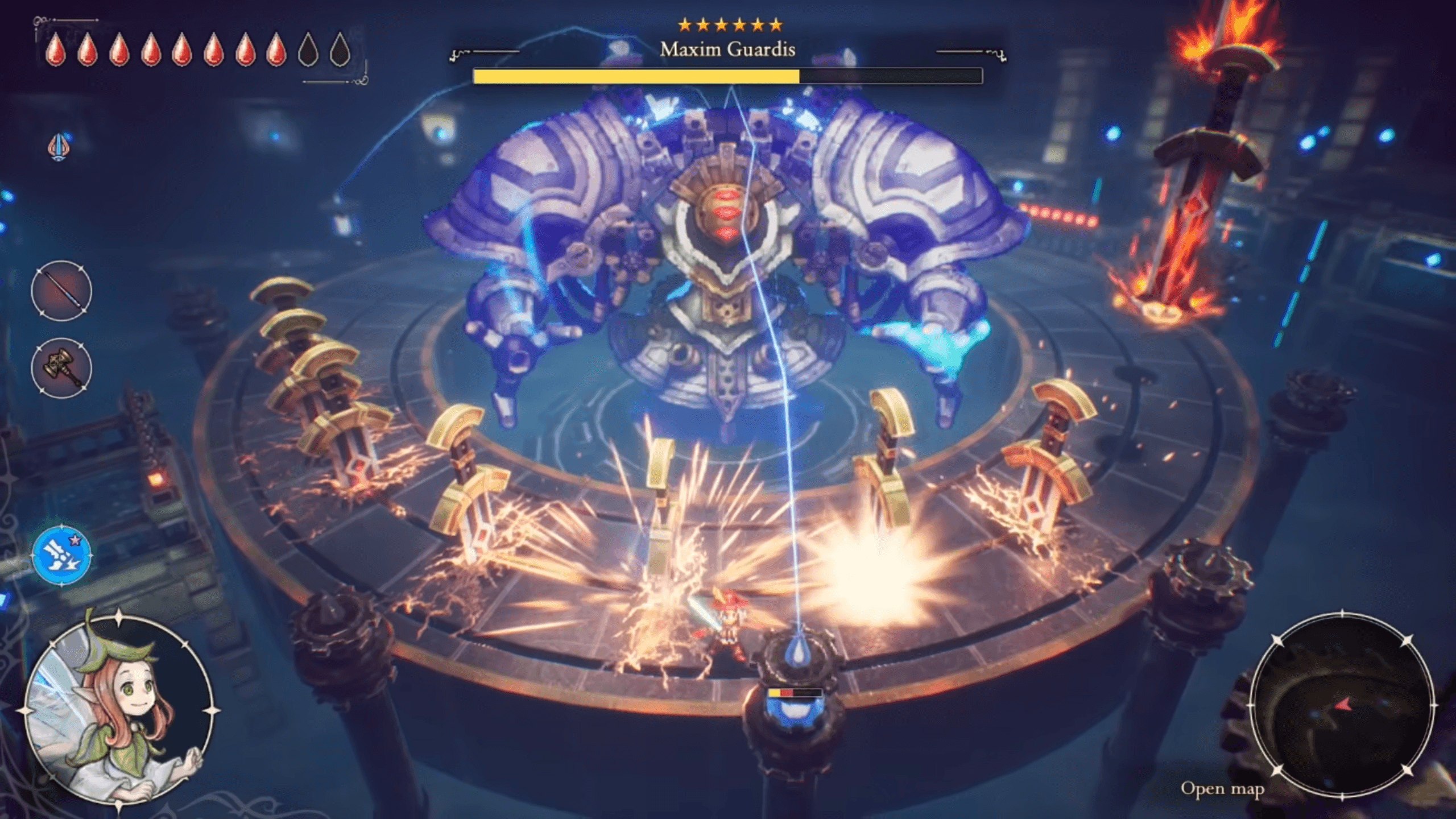
Things get even tougher because once the game abandons turn-based combat, the enemies do too. They're no longer standing politely across from you waiting for their turn. Enemies actively move around the battlefield, attack aggressively, and even deal contact damage just by touching you. Honestly, there were plenty of moments where I felt like I was playing a Metroidvania rather than a traditional action RPG. A lot of the time, I wasn't dying to enemy attacks, I was accidentally bumping into enemies during a messy fight and watching a huge chunk of my health disappear. It's the kind of frustration that's very real in the moment.
The health system reinforces this feeling even further. Instead of a traditional numerical HP bar, the game uses a segmented health system, making every hit feel much more noticeable. Every mistake is immediately visible, constantly reminding you that careless positioning can be costly. Combined with contact damage and environmental hazards, the game often feels surprisingly close to a classic Metroidvania in terms of how it handles danger and survival.
Healing is also fairly limited. During the opening hours, Princess Hildia can occasionally heal you, but once the adventure properly begins, recovery mostly comes from consumable potions that need to be prepared beforehand. In other words, once you run out of supplies in the field, refilling your health isn't always easy. The game does let you carry multiple potion bottles and freely choose whether to fill them with healing, attack-boosting, or defense-boosting brews. That said, let's be honest, most players will probably fill every single bottle with healing potions during the early game. As a result, the offensive and defensive consumables feel a bit overshadowed at first, simply because giving up healing for a temporary buff rarely feels worth the risk.

However, once you reach the mid-to-late game and become more familiar with the enemies, weapons, and Magicite system, the potion system starts to open up in interesting ways. Instead of filling every bottle with healing items, you'll gradually begin experimenting with attack and defense potions to better handle difficult bosses or dangerous areas. At that point, consumables stop being just an emergency survival tool and become part of your overall battle preparation.
As for Faie, once she replaces the princess as your long-term companion, you'll lose that straightforward healing support. But don't make the mistake of underestimating her. Her real value goes far beyond combat or exploration assistance.
That's because Faie can actually revive you on the spot after death. Yes, instead of being sent all the way back to your last save point, Faie can bring you back exactly where you fell. In a game with challenging bosses, tricky platforming, and lengthy dungeons, that's an incredibly valuable safety net.
The catch? She charges you for it.
That's right. This adorable little fairy saves your life, then immediately reaches into your wallet for payment. At times I genuinely couldn't decide whether Faie was my loyal companion or just a very expensive insurance policy following me around for the entire adventure.

Faie, the Adventurer's Best Companion in The Adventures of Elliot: The Millennium Tales
If Elliot is the hero of The Adventures of Elliot, then Faie is undoubtedly the second heart of the entire journey. After the prologue, she officially replaces Princess Hildia as Elliot's long-term companion. While that means losing the princess's straightforward healing support, don't hold it against Faie, because her value goes far beyond that.

As mentioned earlier, healing resources are fairly limited throughout the game, so being sent back to a save point after dying can be a major setback. Thankfully, one of Faie's most useful abilities is her power to revive Elliot on the spot. Instead of forcing you to retrace your steps, she can pull you right back into the action, which is incredibly valuable during difficult exploration sections and boss fights.
There is one small catch, though. she charges you for it. That's right. This tiny fairy saves your life, then immediately takes money out of your pocket. At times, I genuinely couldn't decide whether Faie was my trusted companion or a premium insurance service following me around. Honestly, it's such a ridiculous concept that I feel obligated to complain about it for a second time.
Jokes aside, Faie is one of the best-designed companion characters in the game. She's not just a mascot who follows Elliot around and occasionally delivers cute dialogue. Instead, she's a core part of both combat and exploration. Players can control her directly with the right stick, allowing her to perform actions independently of Elliot. Managing both characters at once can feel a little hectic, but it's also surprisingly engaging and gives you a much stronger sense of involvement.
As the adventure progresses, Faie unlocks a variety of abilities, and nearly all of them serve both combat and exploration purposes. She can set herself on fire and dive into enemies, carry Elliot forward in a quick dash to cross terrain, and most importantly, she can act as a teleport marker that allows Elliot to instantly warp to her location.

That warping ability is easily one of the most useful and enjoyable mechanics in the game.
It can be used to dodge attacks, instantly reposition behind enemies for counterattacks, and reach platforms or hidden areas that initially seem inaccessible. Once you get comfortable with it, you'll naturally start treating Faie as an extension of Elliot rather than a separate system. Especially during boss fights and high-pressure encounters, using teleportation to execute hit-and-run tactics feels incredibly smooth and satisfying.

One of the smartest aspects of Faie's design is that she has her own progression system, and the game cleverly ties many of her upgrades to optional minigames. Rather than feeling like random side activities thrown in for variety, these minigames feel like a natural extension of Faie's abilities.
For example, once Faie learns her fire ability, the game introduces a rhythm-like challenge where players use her to burn flowers falling at different speeds. Later, after unlocking her dash ability, new time-attack challenges become available, rewarding players for mastering her movement. None of these minigames are particularly essential to the main adventure, but because they're directly connected to Faie's growth, they feel far more meaningful than typical side content.
And honestly, Faie is a big part of what makes The Adventures of Elliot: The Millennium Tales stand out from many other action RPGs. She's not just a story companion, nor is she there simply so the protagonist has someone to talk to. She's woven into nearly every aspect of the game. In combat, she creates opportunities. During exploration, she helps you reach new areas. When you die, she can literally pull you back from the brink of failure.
For a price, of course. Yes, I have to complain about this for a third time. The fact that Faie charges you every time she revives you is hilarious enough on its own, but the cost also increases the more often she saves you. She's not just a fairy, she's apparently a revival insurance agent who fully understands surge pricing.
The game does provide a charming explanation, though. Faie simply loves shiny gold coins, which is why she asks Elliot for payment whenever she revives him. It's a detail that perfectly matches her personality, a little greedy, a little mischievous, but ultimately dependable. Even when she's taking your money, it's hard to stay mad at her. After all, she's probably the character who saves your life the most throughout the adventure.

Another welcome addition is the game's dialogue presentation. Unlike most HD-2D titles, The Adventures of Elliot: The Millennium Tales features detailed character portraits during conversations, which I believe is a first for a Team Asano-style HD-2D game. This helps the cast feel far more expressive, and Faie benefits from it more than anyone. Her portrait constantly reacts to what's happening on screen, displaying a wide range of expressions that make her feel lively and full of personality. Combined with her frequent dialogue, she genuinely feels like a companion who's always by your side rather than a simple gameplay mechanic.
Of course, companion characters often run into one common problem: can they become too talkative?
There were definitely moments where Faie pointed out something painfully obvious and made me wonder if she thought I was incapable of figuring things out myself. Thankfully, the game includes an option to reduce or disable frequent companion dialogue. It's a small but important feature that preserves the feeling of having a companion without forcing players to listen to constant reminders and commentary.

Even more surprising is that Faie can actually be controlled by a second player. This gives the game a nostalgic cooperative feel that reminded me a little of Secret of Mana. Square Enix doesn't make many action RPGs with this kind of drop-in cooperative spirit anymore, so it's a nice addition that fits the game's classic adventure atmosphere. I didn't spend enough time with the co-op mode to properly evaluate it, but I can say that even in single-player, controlling both Elliot and Faie feels remarkably smooth and enjoyable.
Overall, Faie is easily one of the game's most successful features. She's a story companion, an exploration tool, a combat mechanic, a revival system, a source of minigames, and one of the most memorable characters in the entire adventure. She transforms the journey from Elliot's solo quest into a true adventure shared with a companion. Sure, she's obsessed with taking your money and occasionally feels like a profit-driven insurance salesperson, but those little quirks are exactly what make her so memorable. For me, Faie isn't just Elliot's partner, she's one of the key reasons this HD-2D action adventure feels so alive.

Audiovisual Presentation of The Adventures of Elliot: The Millennium Tales
If there's one thing that immediately grabs your attention in The Adventures of Elliot, it's undoubtedly the HD-2D presentation. The game retains the nostalgic charm that has become Team Asano's trademark, blending pixel-art characters, detailed environments, dynamic lighting, and layered depth effects into a world that feels both familiar and timeless.
The difference this time is that you're not playing a slow-paced RPG. This is a game built around real-time combat, platforming, exploration, and constant movement. As a result, it feels less like a throwback and more like a modern action RPG wrapped in a classic visual style.
Honestly, I can confidently say this is probably the most impressive HD-2D game I've seen so far. It's not just that the graphics are prettier than before. The amount of environmental detail, lighting work, animation quality, camera direction, and overall presentation feels like a significant leap forward for the style. Some locations are so beautiful that simply stopping to admire the scenery becomes part of the experience, especially when traveling between eras and witnessing how the same world transforms over centuries.

Another standout addition is the inclusion of detailed character portraits during dialogue. Previous HD-2D games often relied entirely on pixel sprites to convey emotion, which certainly had its charm but also came with limitations. Here, the portraits add much more personality and expression to the cast. Characters like Faie benefit enormously from this approach, with her constantly changing expressions making her feel even more lively and memorable. Better yet, the pixel sprites themselves also react during conversations, creating a surprisingly seamless blend between portrait art and in-game animation.

Team Asano has always been good at creating memorable set-piece moments, and that remains true here. Whenever the story reaches an emotional peak or a major confrontation, the game knows exactly how to use lighting, camera angles, and environmental composition to elevate the scene. Despite the characters still being pixel sprites, the scale of the environments and the cinematic presentation create a genuine sense of spectacle. There were multiple moments that honestly gave me goosebumps.
What impressed me most, though, was the camera work. The fixed perspective never feels restrictive. Instead, it allows the developers to carefully frame every scene. Whether it's revealing a distant city skyline, lowering the camera to create tension, or using shafts of light to highlight an important moment, the game constantly demonstrates how well Team Asano understands the strengths of HD-2D.
They're not simply placing pixel characters inside a 3D environment. They're using the visual style itself to tell stories, build atmosphere, and encourage players to pause and appreciate the world around them.

The music is equally impressive. As expected from a Team Asano project, the soundtrack consistently delivers a blend of beauty, emotion, and grand adventure. Fans of Octopath Traveler will immediately recognize that familiar feeling. During exploration, the music carries a sense of wonder and quiet loneliness. In story-heavy moments, it gradually builds emotional weight. And when boss battles or major climaxes arrive, soaring strings, brass, and percussion combine to create exactly the kind of epic fantasy atmosphere you'd hope for.
What makes the soundtrack particularly effective is how well it reflects each era. The Age of Safekeeping carries the noble feel of a traditional fantasy kingdom. The Age of Reconstruction leans into themes of loss and survival. The Age of Magic sounds grander and more prosperous, while the Age of Budding feels primal, mysterious, and full of untamed life. The music doesn't just sound good, it actively helps define the identity of each era and strengthens the sense of traveling through vastly different periods of history.

One feature I particularly appreciated is the ability to collect music tracks through gameplay and listen to them freely through an in-game music player. It's a small addition, but when a soundtrack is this good, giving players a reason to collect and revisit their favorite tracks adds genuine value. If anything, it once again proves my long-standing belief that Square Enix might secretly be a music company that happens to make games on the side.
Overall, the audiovisual presentation is easily one of the game's greatest strengths. The Adventures of Elliot: The Millennium Tales doesn't just push HD-2D technology forward, it successfully demonstrates how the style can evolve beyond traditional RPGs and thrive within a real-time action adventure.
The visuals are stunning, the environments are memorable, the character portraits add personality, the cinematography elevates the storytelling, and the soundtrack remains exceptional throughout. More than anything, the game proves that HD-2D isn't simply a nostalgic art style anymore. It can still grow, evolve, and feel every bit as vibrant as modern game design demands.

The Adventures of Elliot: The Millennium Tales' Final Verdict
Overall, The Adventures of Elliot: The Millennium Tales showed me a side of Team Asano that feels more ambitious and willing to step outside its comfort zone than I expected. Rather than simply relying on the formula that made previous HD-2D titles successful, the team has genuinely tried to push the style in a new direction.
The shift from a turn-based RPG to a real-time action RPG will undoubtedly take some adjustment for players who prefer the more methodical pacing of Octopath Traveler. But that's also what makes The Adventures of Elliot: The Millennium Tales feel so refreshing. Although, I have to admit, the title itself is surprisingly hard to remember. Team Asano may be great at making games, but naming them clearly isn't one of their strongest skills.
Of course, the game isn't without some flaws, albeit a minor one. While the story spans a thousand years and carries a grand sense of scale, the opening hours are undeniably slow-paced. Many side quests still fall into familiar fetch-quest territory, and although the combat is satisfying, the combination of eight-directional movement, contact damage, platforming sections, and limited healing resources makes the game considerably more demanding than it initially appears. There were definitely moments where I felt I wasn't losing to enemies, but to the camera angle, the terrain, or an attack that missed because I was standing just slightly out of position.
Even so, it's hard for me to deny that this was a memorable adventure.

The changing world across different eras is easily one of the game's greatest strengths. Watching the same locations evolve over centuries creates a genuine sense of history and progression. Combined with the addition of platforming, the fixed-camera perspective, and the constant back-and-forth between different time periods, exploration feels far more adventurous than in previous HD-2D titles.
What impressed me most, however, is that Team Asano didn't simply switch the combat to real time and call it a day. They committed to building a proper action RPG framework around it. The seven weapon types each have distinct identities and playstyles, while the Magicite system adds another layer of customization that allows players to gradually develop their own preferred builds and combat approaches.
Then there's Faie, who may very well be the most memorable part of the entire game. She's far more than a story companion. She's integrated into exploration, combat, platforming, revivals, and even minigames. Sure, charging players money for revives makes her feel suspiciously like a greedy merchant at times, but it's exactly that mix of reliability and lovable annoyance that gives her so much personality. She transforms Elliot's adventure from a lonely hero's journey into something that truly feels shared.
And then there's the audiovisual presentation, which is arguably the best HD-2D has ever looked. The stunning environments, the distinct visual identities of each era, the addition of expressive character portraits, the cinematic camera work, and Square Enix's consistently exceptional soundtrack all combine to create a world that genuinely feels grand and worth exploring.
I may not be able to call The Adventures of Elliot: The Millennium Tales the perfect HD-2D game, but I can confidently say it's one of the most important evolutions of the style so far. It proves that HD-2D doesn't have to be limited to nostalgia, turn-based combat, or traditional RPG storytelling. It can run, jump, fight, travel through time, and support a full-fledged action adventure of its own.
And for me, that's exactly what makes The Adventures of Elliot: The Millennium Tales my favorite Team Asano HD-2D game to date.
Game reviewed on PS5. Review copy provided by Square Enix
Review Score
Pros
- One of the most impressive HD-2D presentations to date, featuring stunning environments, excellent cinematography, expressive character portraits, and a superb soundtrack that perfectly captures the spirit of adventure.
- A memorable world spanning four distinct eras, where the same locations evolve dramatically over time, creating a strong sense of history, discovery, and exploration.
- A successful blend of HD-2D and real-time action RPG gameplay, with seven unique weapon types and a flexible Magicite system that add depth and variety to combat.
- Faie is an outstanding companion character, seamlessly integrated into combat, exploration, puzzles, and progression, making her one of the most memorable parts of the entire adventure.
Cons
- Slow-burn opening and pacing issues, as the game spends a considerable amount of time establishing its four eras and world-building before the main story truly gains momentum.
- Some action mechanics can feel frustrating at times, with eight-directional movement, platforming, contact damage, and limited healing resources occasionally creating awkward combat and exploration moments.